
Arms for Ores: Trump’s Foreign Policy in African Security Dilemmas
Sophia Wittemyer, Assistant Editor
swittemyer@acstrap.com
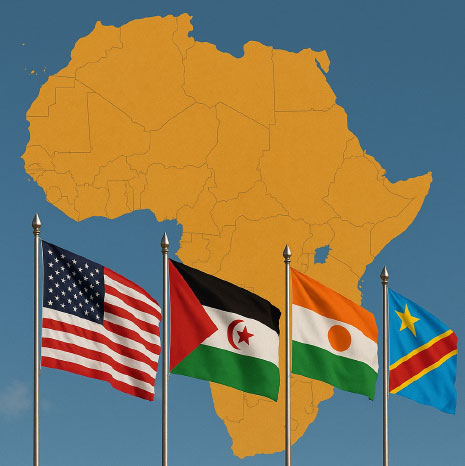
This article analyzes Donald Trump’s first and current administration’s foreign policy in Africa to understand the geopolitical and security policy implications of U.S. action in the region. Comparing cases of bilateralism between the United States and African states with interstate conflict—the Sahrawi Arab Democratic Republic, the Sahel, and the Democratic Republic of the Congo—suggests the following diplomatic shifts in the U.S.’s engagement with the continent: decreased multilateralism, expanded private sector investment, and increased American-led militarization in African interstate conflicts.
Introduction
Donald Trump’s administration presents an exacerbated example of patronage in American leadership; Trump has selected advisors with whom he is personally connected, and who closely reflect his moral and political values. Trump’s removal of advisors who do not share his opinions deviates from the traditional committee of advisors. This client-patron circle of specialists marks his administration as a representation and reflection of himself.
In this article, I compare the Trump administration’s security decisions, bilateral agreements, and involvement in interstate conflicts to predict the next four years of American attitudes toward a diverse continent. By positioning the U.S.’s view of Africa within the nexus of great powers’ struggle for hegemony in the Global South, I select highly polarized regional case studies, and I analyze the U.S.’s foreign policy response as indicators of the administration’s broader Africa strategy. Thus, the following criteria serve as my preconditions for case selection: a conflict involving high stakes, interstate actors, a great international power, and a large market size. These conditions enable a comparison of regionalism and the interests of multiple countries within a single crisis. The selected case studies—the Sahrawi Arab Democratic Republic (SADR or Western Sahara), the Sahel, and the Democratic Republic of the Congo—encompass crises involving multiple regional actors, international engagement, large markets, and elevated economic, political, or humanitarian stakes.
First, I will provide a brief historical background of each conflict, offering necessary context before analyzing the actions of the Trump administration in each case. Drawing on trends in American engagement, both past and present, I will offer predictions on what to expect from the next four years of the Trump administration’s bilateral engagements in Africa.
The Sahrawi Arab Democratic Republic
History
Under Moroccan occupation, the Sahrawi Arab Democratic Republic (SADR), sometimes referred to as Africa’s last colony, remains a contested state.
Following Spain’s official colonial withdrawal from the Spanish Sahara in 1975, Morocco began a military campaign against the Provisional Sahrawi National Council of the Popular Front for the Liberation of Saguia el Hamra and Río de Oro (Polisario Front)—SADR’s formal government.1Staff Researcher. “War and Insurgency in the Western Sahara.” Strategic Studies Institute, US Army War College, 2013. An intense and violent war ensued between Mauritania, Morocco, and the Polisario Front, causing a massive refugee movement of Sahrawis into Algerian refugee camps. Shortly after, upon discovering the natural resource value in SADR, the United States heavily backed Morocco’s attempted occupation.2Staff Researcher. “War and Insurgency in the Western Sahara.” Strategic Studies Institute, US Army War College, 2013. After ten years of waging an unwinnable war on both sides, the conflict shifted into the diplomatic sphere, ultimately ending in a stalemate.
SADR, a member state of the African Union (AU) and a recognized state under international law,3International Court of Justice Advisory Opinion. Accordance with international law of the unilateral declaration of independence in respect of Kosovo. General List No. 64. 298. October 16, 1975. continues to fight Moroccan territorial claims. Algeria has backed the Polisario Front for over sixty years and remains engaged in the struggle for Sahrawi statehood, creating contentious interstate relations in North Africa. International actors play a key role in SADR’s contested statehood. By recognizing either Morocco’s territorial claims or SADR’s independence, international actors influence the endorsement or rejection of SADR’s legitimacy as a state.
Past
Under the first Trump administration, the United States notably recognized Moroccan sovereignty over the territory of Western Sahara,4Trump, Donald. “Proclamation on Recognizing The Sovereignty Of The Kingdom Of Morocco Over The Western Sahara.” National Archives and Records Administration, December 10, 2020. departing from long-standing U.S. diplomatic silence on the conflict. However, Trump’s administration also vocalizes an ongoing, decades-old American support of Morocco militarily.5Zunes, Stephen. “The United States and Morocco: The Sahara War and Regional Interests.” Arab Studies Quarterly 9, no. 4 (1987): 422–41. In December 2020, the U.S. recognized Moroccan sovereignty over the disputed region in exchange for Morocco’s normalization of relations with Israel.6Trump, Donald. “Proclamation on Recognizing The Sovereignty Of The Kingdom Of Morocco.” National Archives and Records Administration, December 10, 2020. Proponents of the Sahrawi people’s right to self-determination and international legal norms widely criticized this recognition, 7See Perry, Andre M., Jonathan Rauch, Kent E. Calder, Tamara Cofman Wittes Natan Sachs, Adrianna Pita Natan Sachs, Yasmina Abouzzohour, Sally Paxton George Ingram, and Jordan Muchnick William A. Galston. “Morocco’s Partial Normalization with Israel Comes with Risks and Gains,” March 9, 2022. & Algeria rejects Trump’s stance on Western Sahara, December 12, 2020. as the status of SADR remains unresolved and governed by United Nations resolutions calling for a referendum on self-determination.
This action normalized Moroccan claims over SADR, prompting states such as Spain (2022),8“Parliamentary Question: Spanish Recognition of the Moroccan Plan for Autonomy for Western Sahara.” Question for written answer E-001162/2022, March 21, 2022. and France (2024) to follow suit, despite earlier reservations.9Emmanuel Macron Au Maroc : Son Allocution Devant Le Parlement Marocain .” FRANCE 24, October 29, 2024. The Trump administration’s foreign policy approach in Western Sahara prioritized transactional deals with Morocco, which included investments and expansions of green energy companies in the territory.10Yerkes, Sarah, and Natalie Triche. Trump’s Lesser-Known Deal of the Century? Resolving the Western Sahara Conflict, February 19, 2025. While the 2006 U.S.-Morocco Free Trade Agreement limited American trade to Morocco’s territory, the Trump administration’s normalization of claims in the Western Sahara increased market possibilities.11Yerkes, Sarah, and Natalie Triche. Trump’s Lesser-Known Deal of the Century? Resolving the Western Sahara Conflict, February 19, 2025. The agreement required Moroccan recognition of Israel in exchange for sovereignty over Western Sahara12Perry, Andre M., et al. “Morocco’s Partial Normalization with Israel Comes with Risks and Gains,” March 9, 2022. –at the expense of international law related to self-determination and human rights. During his time in office, President Biden did not reverse this position, and with President Trump leading the country again, the sovereignty of the Sahrawi Arab Democratic Republic and the rights of the Sahrawi people remain at stake.
Present
On April 8th, 2025, the second Trump administration reiterated its support for Morocco’s position in Western Sahara, undermining international efforts to resolve the conflict and respect the right of the Sahrawi people to determine their future.13Office of the Spokesperson. Secretary Rubio’s Meeting with Moroccan Foreign Minister Bourita, April 8, 2025. The Trump administration stated that the Moroccan “Autonomy Proposal”, which grants Morocco sovereignty over SADR territory, will be the only resolution for the future of the Sahrawi people.14Office of the Spokesperson. Secretary Rubio’s Meeting with Moroccan Foreign Minister Bourita, April 8, 2025. As part of Trump’s Executive Order for Reciprocal Tariffs,15“Regulating Imports with a Reciprocal Tariff to Rectify Trade Practices That Contribute to Large and Persistent Annual United States Goods Trade Deficits.” The White House, April 3, 2025. Trump enacted 10% tariffs on Moroccan goods on April 3rd, 2025.16“Full List of Trump’s Tariffs: A Country-by-Country Look after the 90-Day Pause.” The Guardian, April 9, 2025. The relatively low tariff on Morocco, compared to other regional states, suggests a continuously positive bilateral relationship between the Trump administration and Morocco, consistent with the actions of the first Trump administration.
Future Ramifications
The Trump administration’s decision to normalize the Sahrawi Arab Democratic Republic (SADR) under the Kingdom of Morocco jeopardizes its contested statehood. SADR, a territory repeatedly subjected to human rights violations by the state of Morocco, will further lose its right to self-determination given the American rejection of SADR sovereignty.17Zunes, Stephen, and Jacob Mundy. “The Sahrawi Intifada: Western Saharan Nationalism under Moroccan Occupation.” In Western Sahara: War, Nationalism, and Conflict Irresolution, Second Edition, 2nd ed., 140–66. Syracuse University Press, 2022. Trump’s continued support of Moroccan sovereignty over SADR will decrease the likelihood of international support for the sovereignty of the Sahrawi people. Such a position also drastically reduces the possibility that the United States could serve as a potential mediator for a compromise between Morocco and SADR, considering their bias towards Morocco. Additionally, the expansion of American investment in Morocco’s private sector, particularly in Morocco’s Western Sahara, could increase the occupation and extraction of SADR’s natural resources.
Given that the United States’ diplomatic decisions tend to set the standard for international diplomatic decisions, Trump’s normalization of Western Sahara as the territory of Morocco paved the way for French and Spanish policy. With President Macron of France showing further support for the Moroccan Autonomy Plan, it will be challenging for the Sahrawi people to seek support from elsewhere other than international courts.18Emmanuel Macron Au Maroc : Son Allocution Devant Le Parlement Marocain .” FRANCE 24, October 29, 2024.
The Sahel
History
Economically, the African continent has become a battleground for influence, energy, and power over the past ten years. Chinese infrastructural investments created allies and a “debt trap” in multiple African nations.19Dollar, David. Understanding China’s Belt and Road Infrastructure Projects in Africa, September 7, 2023. Through the Belt and Road Initiative (BRI), China implemented a series of intense and strategic foreign policy investments, adding to its geopolitical influence in the region. Key signatories to the BRI comprise members of the African Union, including nations in the Sahel: Mali, Niger, Chad, Nigeria, Mauritania, and Sudan.20Countries of the Belt and Road Initiative (BRI). Green Finance & Development Center. February 4, 2025. While China’s debt traps largely mirror those of the International Monetary Fund or the World Bank, the loan agreements with China do not include “Good Governance” contingencies—conditions included in Western aid deals requiring democratic governance, protection of human rights, and fundamental freedoms.21Congress. “Democracy and Human Rights in U.S. Foreign Policy: Evolution, Tools, and Considerations for Congress.” June 4, 2025. By staying out of state politics via China’s No-Conditions-for-Load Policy, China strays from typical international loans.22See, Dynamic, Beyongo Mukete. “CHINESE LOANS TO AFRICA: TRAP OR TREASURE?” In Crisis, edited by Jane Golley, Linda Jaivin, and Sharon Strange, 243–48. ANU Press, 2021. & “Conditionality in China’s Aid Model.” Carnegie Endowment for International Peace, January 10, 2012.
Militarily, the Sahel became a hotbed for terrorism in the 2000s, instigating conversations among Europe and the U.S. on how to advance counterterrorism efforts.23See Boserup, Rasmus Alenius, and Luis Martinez. “French Counterterrorism.” Europe and the Sahel-Maghreb Crisis. Danish Institute for International Studies, 2018. & Zoubir, Yahia H. “The United States and Maghreb-Sahel Security.” International Affairs (Royal Institute of International Affairs 1944-) 85, no. 5. 2009. 977–95. Former colonial power France launched Operation Barkhane in 2014, sending 5,100 troops into northern Mali.24Olech A. French Operation Barkhane in Africa – success or failure? [version 1; peer review: 3 approved]. Stosunki Międzynarodowe – International Relations 2023, 3:17 https://doi.org/10.12688/stomiedintrelat.17737.1 Following its own “War on Terror” roadmap, the U.S. placed Africa at the forefront of counterterrorism initiatives in 2008, coordinating Sahelian military goals under the Trans-Sahara Counterterrorism Initiative or Partnership (TSCIP)25Zoubir, Yahia H. “The United States and Maghreb-Sahel Security.” International Affairs (Royal Institute of International Affairs 1944-) 85, no. 5. 2009. 977–95. and later by bilaterally supporting the G5 Sahel—a regional counterterrorism organization amongst Burkina Faso, Chad, Niger, Mali, and Mauritania.26Zimmerman, Katherine. “No Competition Without Presence: Should the U.S. Leave Africa?”.” PRISM 9, no. 1 (2020): 68–87.
Burkina Faso, Mali, and Niger saw complete American and French troop withdrawal and loss of Western Support in their fight against transnational terrorism following violations of democratic norms on transitioning power.27Kabandula, Abigail. “US withdrawal from Niger signals a shift in Western influence in the Sahel.” 2024. The aftermath of Niger’s 2023 coup further undermined the American military presence in the region, as its withdrawal resulted in the loss of a key foothold in the Sahel. Coups in these three states have created openings for encroaching Russian paramilitary groups involved in combating transnational terrorists. Support from the former Wagner Group, now Russia’s Africa Corps, has brought Russian troops into former U.S. military bases,28Kumar, Riza. “The Wagner Group in the Central Sahel: Decolonization or Destabilization.” Counter Extremism Project. 2023. shifting international influence in the Sahel and parting from decades of French and American military support.
Since 2020, West Africa has experienced surges in coups (in Mali, Burkina Faso, Niger), junta support for one another, backlash against regional organizations, and democratic backsliding.29Lawal, Shola. “Niger Coup: Divisions as ECOWAS Military Threat Fails to Play Out.” Al Jazeera, August 6, 2023. Coups d’état in the Sahel have delayed China’s development, as ongoing political instability and economic uncertainty undermine long-term investment and engagement. The Economic Community of West African States (ECOWAS), a regional economic organization, attempted to reverse the 2023 Niger junta’s actions through sanctions and proposed intervention. Contrary to prior ECOWAS interventions in Sahel coups, the threat of military intervention to restore presidential order resulted in an abnormal threat of defensive war from Mali, Niger, and Burkina Faso.30Obasi, Nnamdi. ECOWAS, Nigeria and the Niger Coup Sanctions: Time to Recalibrate, December 5, 2023. While the conflict never came to blows, all three Sahel states formally removed themselves from ECOWAS.31“Burkina Faso, Mali and Niger’s Withdrawal from ECOWAS Is Now a Reality.” Press Release Economic Community of West African States, January 30, 2025.
It remains to be seen whether interim presidents General Abdourahamane Tchiani, Captain Ibrahim Traoré, and General Assimi Goïta, who have turned towards internal relationships via the Alliance of Sahel States, will prove beneficial for their states’ future. Local populations in Niger, Mali, and Burkina Faso have differing approval of the leaders, with 66% trusting their respective President “a lot” or “somewhat” and 31% trusting the President either “just a little” or “not at all.”32“Afrobarometer (R9 2021/2023) Trust President: Niger, Mali, Burkina Faso.” Afrobarometer Online Data Analysis (ODA). Since 2023, Burkina Faso’s interim junta President Ibrahim Traoré began and reinforced a bilateral relationship with Russia.33See “Ibrahim Traoré, Russian Influence, and U.S. Policy Challenges.” Robert Lansing Institute, February 25, 2025. & “Meeting with Interim President of Burkina Faso Ibrahim Traore.” President of Russia, July 29, 2023. Negotiations on security-for-resource agreements between Traoré and Russian Foreign Minister Sergey Lavrov began an influx of Russian troops fighting Jihadists within Burkinabe borders. May 2025 brought an alleged 1,700 Russian troops to Burkina Faso—not yet confirmed by either government or news sources.34“1700 Russian Commandos Land in Burkina Faso – A Bold Message to the West.” YouTube, May 6, 2025. The Alliance of Sahel States, which has increasingly turned to Russia and Russia’s Africa Corps for international support, may encourage Trump’s interest in the region, specifically in creating agreements that favor private sector investment and avoid democratic contingencies.
Past
During his first term, the Trump administration pushed infrastructural development in West Africa, working with various governments to “level the playing field for U.S. companies and encourage U.S. companies to do business in Africa.”35“The Trump Administration and U.S. Africa Policy: What Has Been Accomplished and What Lies Ahead?” US Embassy in Senegal, March 5, 2020. He also cited the need to compete with China in the region, assuring states that America has an unmatched regional commitment.36“The Trump Administration and U.S. Africa Policy.” March 5, 2020. Project “Niger Compact,” 37A2F Consulting. “Niger Compact – Regional Sahel Pastoralism Support (PRAPS): Design Report.” Washington, DC: Millennium Challenge Corporation, June 30, 2023. carried out by the now-defunct Millennium Challenge Corporation (MCC), officially commenced under the first Trump administration and ended in 2023, contributing $441 million towards improving the agriculture sector in Niger. The MCC projects the investment to impact four million individuals over the next 20 years.38A2F Consulting. “Niger Compact.” Millennium Challenge Corporation, 2023.
Present
The Trump administration’s commitment to infrastructural investment appears to have decreased, favoring private sector investment in exchange for security rather than government restructuring and support.39Bartlett, Kate. “Mineral-Rich, War-Torn DRC First Stop for Trump’s New Africa Czar,” April 3, 2025. Recently, Donald Trump and Elon Musk publicly stated their decision to dismantle the MCC, through the Department of Government Efficiency (DOGE).40“After USAID, Donald Trump pulls the plug on infrastructure player MCC,” The Africa Report. April 24, 2025. Trump stated that he opposes development aid, as it does not directly benefit the United States.41“After USAID, Donald Trump pulls the plug on infrastructure player MCC,” The Africa Report. April 24, 2025. The primary difference between Trump’s bilateral agreements and those of the MCC is the reciprocal nature of the gains. Both increase private investments in Africa, but the MCC does so through providing funding for social and economic programs, whereas Trump wishes to provide military personnel.42Trump shuts down Millennium Challenge Corporation as he disengages from Africa, April 24, 2025. Trump’s new foreign policy demonstrates a race for resources, offering reciprocal benefits such as security or recognition for private sector investments. He shifts away from providing social welfare support and toward military might; the recent U.S.-Ukraine Minerals Deal demonstrates the Trump administration’s exchange of physical security contributions in exchange for resources.43Baskaran, Gracelin, and Meredith Schwartz. “What to Know About the Signed U.S.-Ukraine Minerals Deal.” Center for Strategic & International Studies, May 1, 2025. While the administration has not yet enacted agreements following these objectives in the Sahel, U.S. Senior Advisor Massad Boulos’ current initiatives from his official trip across the MENA region, such as the recent Declaration of Principles in the DRC or Saudi Arabia, suggest a resources-for-security trend.44See Tertrais, Bruno. “Uranium from Niger: A Key Resource of Diminishing Importance for France.” Danish Institute for International Studies, 2014. & “Declaration of Principles.” U.S. Department of State Bureau of African Affairs, April 25, 2025. Massad Boulos reflects Trump’s privatized interests and presence in the Sahel, which would enable access to valuable uranium deposits.
Interestingly, pro-Trump movements in the Sahel support Trump’s second administration as being “anti-imperialist”, “advocat[or] for traditional values”, and “peacemak[ing].”45Tschörner, Lisa. “Debating Trump 2.0 and Implications for Africa – ‘We’re All Trumpists Here’: Why the Election of the New US President Is Welcomed in the Sahel .” Stiftung Wissenschaft und Politik, April 2, 2025. The support creates a foundation that encourages Trump’s involvement in the Sahel. Additionally, the National Sahel News outlet announced its support for Trump, citing his dedication to ending the Russo-Ukrainian war and valuing anti-imperialism.46Sanda, Siradji. “Billet: Trump Triomphe: Espoirs et Désespoirs .” Office National D’Edition et de Presse, November 7, 2024. Given the recency of Trump’s second administration, it remains to be seen if the majority of local populations favor Trump and how his popularity could influence bilateral agreements.
Future Ramifications
Increased American military sponsorship in the Sahel will escalate interstate conflict amid current border tensions. The Trump administration has eliminated the Millennium Challenge Corporation, resulting in a decrease in infrastructure and capacity-building spending.47Runde, Daniel F., Richard Crespin, and James Mazzarella. “Preserve the Dealmaking Capability of the Millennium Challenge Corporation.” Center for Strategic & International Studies, April 25, 2025. Removing established corporations, with decade-long private investment projects, shifts bilateral agreements onto the Trump administration as the decision-maker for a means of reciprocity in resource markets of post-coup states. Tensions will likely escalate, along with the means to act on those tensions. While Trump’s dissolution of the MCC does not directly support junta governments, his commitment to providing security instead of social investment aligns with the ideology of junta militants in the Sahel. Heightened militarization of the Sahel would further exacerbate a division between the Alliance of the Sahel and preexisting regional organizations, such as the Economic Community of West African States (ECOWAS) or the African Union (AU).
While increased U.S. private sector funding in West Africa appears fruitful, I pose that Trump’s agenda will support current, authoritarian governments–including the coup juntas in Mali, Burkina Faso, and Niger–who severed ties with the long-standing Economic Community of West African States.48“The Withdrawal of Three West African States from ECOWAS.” International Institute for Strategic Studies, June 2024. As malleable and young governments lacking international legitimacy, the Trump administration could integrate multilateral relationships with junta governments easily, breaking from normative American protocols following coups. Donald Trump may eliminate democratic contingencies on government development and focus on business deals in exchange for reinstated military protection.
Democratic Republic of the Congo
History
Since 1996, the Rwandan genocide and territorial border tensions between Rwanda and the Democratic Republic of the Congo perpetuate ongoing violence and killings in the Eastern DRC.49“Conflict in the Democratic Republic of Congo .” Global Conflict Tracker Council on Foreign Relations, March 20, 2025. The DRC, Rwanda, and numerous armed groups have engaged in a series of border wars.50“Conflict in the Democratic Republic of Congo .” Council on Foreign Relations, March 20, 2025. Since 2000, the M23–an armed group fighting the Congolese government–consists of ethnic Tutsis supported by the Rwandan state. M23 and the Democratic Republic of Congo’s competition over border lands and minerals persists today, leaving the dispute in the eastern DRC a major humanitarian crisis.51“Conflict in the Democratic Republic of Congo .” Council on Foreign Relations, March 20, 2025. International interest in the precious metals located within the border region sparked global involvement in the crisis.
Past
Under the “America First” initiative, Trump withdrew security support for the Democratic Republic of Congo. In 2018, the First Trump administration cut U.S. funding to the United Nations, eliminating funds allocated for peacekeepers in the border crisis.52National Security and Defense. “President Donald J. Trump’s Foreign Policy Puts America First.” National Archives and Records Administration, January 30, 2018. The M23, who pulled away from the conflict for five years, subsequently reappeared in 2022.53“Conflict in the Democratic Republic of Congo .” Council on Foreign Relations, March 20, 2025. Trump’s withdrawal of American funding to the United Nations Organization Stabilization Mission in the Democratic Republic of the Congo (MONUSCO)54“MONUSCO Fact Sheet.” United Nations Peacekeeping, July 2010. has likely increased the presence of M23 on the eastern border of the DR Congo.
Economically, the DRC sold half its cobalt mines to Chinese companies, shifting ownership away from prominent American investors in the DRC.55Gregory, Farrell, and Paul J. Milas. “China in the Democratic Republic of the Congo: A new dynamic in critical mineral procurement,” US Army War College – Strategic Studies Institute. October 17, 2024. China currently controls 80% of cobalt output in the DRC.56Gregory, Farrell, and Paul J. Milas. “China in the Democratic Republic of the Congo,” US Army War College – Strategic Studies Institute. October 17, 2024.
Present
On April 3rd, 2025, the Trump administration’s Senior Advisor for Africa, Massad Boulos, committed to a bilateral treaty with President Felix Tshisekedi and the Congolese government.57“Reçu Par Le Président Félix Tshisekedi, Le Conseiller Principal Pour l’Afrique de Donald Trump a Dit Que Les USA Restent Déterminés à Soutenir La Fin de La Guerre.” Présidence de la République démocratique du Congo, April 3, 2025. Shifting to direct American involvement in the border crisis, rather than the previous UN peacekeeping efforts, establishes a new American military presence in the eastern DRC. The treaty ensures American private sector development of mining industries in the DRC Great Lakes region. These multi-million-dollar investments require a secure region to operate, which the Trump administration committed to providing reciprocally by “supporting the end of the war.58“Reçu Par Le Président Félix Tshisekedi.” Présidence de la République démocratique du Congo, April 3, 2025.
Future Ramifications
Trump’s shift from multilateralism in Africa, using the American private sector as a proxy for state interests rather than a long-standing multilateral organization, may create more anti-American sentiment in foreign nations. Using the American military to quell an interstate dispute, like U.S. counterterrorism methods in the Sahel, ultimately ignores the complexity and nuance of the conflict on DR Congo’s eastern border. The United Nations and peacekeeping forces better suit the current security needs of DR Congo–a crisis requiring engagement and knowledge beyond one administration’s business interests.
Current bilateral agreements in the Middle East suggest a trend in the Trump administration’s security-for-resources foreign policy. Under the 2025 U.S.-Saudi arms deal, the Trump administration committed $142 billion in American weapons to the Saudi government in exchange for access to development in energy infrastructure and mineral resources.59“US and Saudi Arabia Agree to $142bn Weapons Sale During Trump Visit.” Al Jazeera, May 13, 2025. The Trump administration’s decision to offer security in exchange for access to natural resource markets is likely to become a trend in its future agreements with African states.
Conclusion
The Trump administration’s foreign policy in Africa serves as a significant indicator of America’s declining multilateralism and increasing securitization in African interstate conflict zones. Analyzing African case studies, which include interstate conflict, regional engagement, a great power, a large market, and high economic and humanitarian stakes, provides reliable inferences about Trump’s overall approach to African foreign policy.
Through comparing the cases of Western Sahara, the Sahel, and the DRC, a continuous administrative pattern emerges in Trump’s foreign policy in Africa. Trump’s continued emphasis on private sector investment in exchange for security reinforces his approach to foreign policy in West Africa. Shifting away from multinational organizations, such as the United Nations, the Trump administration sets new expectations for receiving aid or incentives from the United States for oppositional governments—expectations that ensure legitimization and security by the United States in exchange for privatized involvement in natural resources. The Trump administration follows similar bilateral agreement goals of past administrations, however, following a new format which lacks multilateralism and emphasizes privatized business.
The Trump administration’s prioritization of business has led to and will continue to lead to the creation of new bilateral agreements with African states. By prioritizing private sector investment in exchange for American military protection, or legitimacy, the Trump administration shifts the United States’ foreign policy in Africa away from multilateralism. Creating bilateral relationships based on privatized markets may fuel local conflicts, encourage autocratic regimes, and delegitimize nuanced, decades-long struggles. Replacing diverse objectives, such as democratic governance, infrastructural development, humanitarian efforts, securitization, and economics, with a narrow focus on economic advancement compromises the beneficial, nuanced support that the United States provides. Shifting focus away from infrastructure and democracy onto securitization and economics may encourage the African government to prioritize economic deals over other crucial, vulnerable foundations, such as democratic rule, free and fair elections, or infrastructural development projects.
The Trump administration’s commitment to arming or legitimizing various African states against one another fuels ethnic violence and interstate conflicts instead of reducing them. The administration is focused on expanding private industries in conflict-affected countries, rather than adhering to the principles of non-interference in these areas. More importantly, the decision to arm one side does not stem from a nuanced understanding of conflict; instead, the Trump administration’s decision to pick sides is driven by monetary incentives and private sector investment. This business mentality prioritizes investment in exchange for arms without regard for the future implications of such a profit-driven approach. If the Trump administration does not adhere to state context and cultural nuance, its missteps could lead to severe repercussions—economic corruption of local governments, statelessness, and even the prospect of interstate war.
Endnotes
“1700 Russian Commandos Land in Burkina Faso – A Bold Message to the West.” YouTube, May 6, 2025. https://www.youtube.com/watch?v=s8XIUFGj6Kg.
A2F Consulting. “Niger Compact – Regional Sahel Pastoralism Support (PRAPS): Design Report.” Washington, DC: Millennium Challenge Corporation, June 30, 2023.
“Afrobarometer (R9 2021/2023) Trust President: Niger, Mali, Burkina Faso.” Afrobarometer Online Data Analysis (ODA). https://www.afrobarometer.org/online-data-analysis/.
“After USAID, Donald Trump pulls the plug on infrastructure player MCC,” The Africa Report. April 24, 2025. https://www.theafricareport.com/382346/after-usaid-donald-trump-pulls-the-plug-on-infrastructure-player-mcc.
Algeria rejects Trump’s stance on Western Sahara, December 12, 2020. https://www.reuters.com/article/world/algeria-rejects-trumps-stance-on-western-sahara-idUSKBN28M0MZ/.
Bartlett, Kate. “Mineral-Rich, War-Torn DRC First Stop for Trump’s New Africa Czar,” April 3, 2025. https://www.npr.org/2025/04/03/nx-s1-5350980/mineral-rich-war-torn-drc-first-stop-for-trumps-new-africa-czar.
Baskaran, Gracelin, and Meredith Schwartz. “What to Know About the Signed U.S.-Ukraine Minerals Deal.” Center for Strategic & International Studies, May 1, 2025. https://www.csis.org/analysis/what-know-about-signed-us-ukraine-minerals-deal?fbclid=IwY2xjawKRn2lleHRuA2FlbQIxMQBicmlkETFvcXRhWmNhNzlnNHNsTW84AR7SJJAu2COkO-K9j3irmWn3Kr_KawDP-J9mQuvbsd804MiUEIp5Uv1_ikrH_Q_aem_7xTs0dysY7tiFDwnb-GkTA.
Boserup, Rasmus Alenius, and Luis Martinez. “French Counterterrorism.” Europe and the Sahel-Maghreb Crisis. Danish Institute for International Studies, 2018. http://www.jstor.org/stable/resrep17370.8.
“Burkina Faso, Mali and Niger’s Withdrawal from ECOWAS Is Now a Reality.” Press Release Economic Community of West African States, January 30, 2025. https://ecowas.int/burkina-faso-mali-and-nigers-withdrawal-from-ecowas-is-now-a-reality/.
“Conflict in the Democratic Republic of Congo.” Global Conflict Tracker Council on Foreign Relations, March 20, 2025. https://www.cfr.org/global-conflict-tracker/conflict/violence-democratic-republic-congo.
Congress. “Democracy and Human Rights in U.S. Foreign Policy: Evolution, Tools, and Considerations for Congress.” June 4, 2025. https://www.congress.gov/crs-product/R47890.
“Conditionality in China’s Aid Model.” Carnegie Endowment for International Peace, January 10, 2012. https://carnegieendowment.org/events/2012/01/conditionality-in-chinas-aid-model?lang=en.
Countries of the Belt and Road Initiative (BRI). Green Finance & Development Center. February 4, 2025. https://greenfdc.org/countries-of-the-belt-and-road-initiative-bri/.
“Declaration of Principles.” U.S. Department of State Bureau of African Affairs, April 25, 2025. https://www.state.gov/releases/bureau-of-african-affairs/2025/04/declaration-of-principles/.
Dollar, David. Understanding China’s Belt and Road Infrastructure Projects in Africa, September 7, 2023. https://www.brookings.edu/articles/understanding-chinas-belt-and-road-infrastructure-projects-in-africa/.
Dynamic, Beyongo Mukete. “CHINESE LOANS TO AFRICA: TRAP OR TREASURE?” In Crisis, edited by Jane Golley, Linda Jaivin, and Sharon Strange, 243–48. ANU Press, (2021). https://doi.org/10.2307/j.ctv1m9x316.26.
“Emmanuel Macron Au Maroc : Son Allocution Devant Le Parlement Marocain .” France 24, October 29, 2024. https://www.youtube.com/watch?v=EiDYXjf_284.
“France’s Western Sahara Shift.” Robert Lansing Institute, August 9, 2024. https://lansinginstitute.org/2024/08/09/frances-western-sahara-shift/.
“Full List of Trump’s Tariffs: A Country-by-Country Look after the 90-Day Pause.” The Guardian, April 9, 2025. https://www.theguardian.com/us-news/2025/apr/09/trump-tariffs-list-pause.
Gregory, Farrell, and Paul J. Milas. China in the Democratic Republic of the Congo: A new dynamic in critical mineral procureme, October 17, 2024. https://ssi.armywarcollege.edu/SSI-Media/Recent-Publications/Article/3938204/china-in-the-democratic-republic-of-the-congo-a-new-dynamic-in-critical-mineral/.
“Ibrahim Traoré, Russian Influence, and U.S. Policy Challenges.” Robert Lansing Institute, February 25, 2025. https://lansinginstitute.org/2025/02/25/ibrahim-traore-russian-influence-and-u-s-policy-challenges/.
International Court of Justice Advisory Opinion. Accordance with international law of the unilateral declaration of independence in respect of Kosovo. General List No. 64. 298. October 16, 1975. https://www.icj-cij.org/case/141
Kabandula, Abigail. “US withdrawal from Niger signals a shift in Western influence in the Sahel.” 2024.
Kumar, Riza. “The Wagner Group in the Central Sahel: Decolonization or Destabilization.”Counter Extremism Project. 2023. https://www.counterextremism.com/press/new-cep-report-wagner-group-central-sahel-decolonization-or-destabilization.
Lawal, Shola. “Niger Coup: Divisions as ECOWAS Military Threat Fails to Play Out.” Al Jazeera, August 6, 2023. https://www.aljazeera.com/news/2023/8/6/niger-coup-divisions-as-ecowas-military-threat-fails-to-play-out#:~:text=But%20ECOWAS’s%20combative%20response%20to,bordering%20Mali%20and%20Burkina%20Faso.
“Meeting with Interim President of Burkina Faso Ibrahim Traore.” President of Russia, July 29,2023. http://en.kremlin.ru/events/president/news/71838.
“MONUSCO Fact Sheet.” United Nations Peacekeeping, July 2010. https://peacekeeping.un.org/en/mission/monusco.
National Security and Defense. “President Donald J. Trump’s Foreign Policy Puts America First.” National Archives and Records Administration, January 30, 2018. https://trumpwhitehouse.archives.gov/briefings-statements/president-donald-j-trumps-foreign-policy-puts-america-first/.
Obasi, Nnamdi. ECOWAS, Nigeria and the Niger Coup Sanctions: Time to Recalibrate, December 5, 2023. https://www.crisisgroup.org/africa/sahel/niger/ecowas-nigeria-and-niger-coup-sanctions-time-recalibrate.
Office of the Spokesperson. Secretary Rubio’s Meeting with Moroccan Foreign Minister Bourita, April 8, 2025. https://www.state.gov/secretary-rubios-meeting-with-moroccan-foreign-minister-bourita/.
Olech A. French Operation Barkhane in Africa – success or failure? [version 1; peer review: 3 approved]. Stosunki Międzynarodowe – International Relations (2023), 3:17 https://doi.org/10.12688/stomiedintrelat.17737.1
“Parliamentary Question: Spanish Recognition of the Moroccan Plan for Autonomy for Western Sahara.” Question for written answer E-001162/2022, March 21, 2022. https://www.europarl.europa.eu/doceo/document/E-9-2022-001162_EN.html.
Perry, Andre M., Jonathan Rauch, Kent E. Calder, Tamara Cofman Wittes Natan Sachs, Adrianna Pita Natan Sachs, Yasmina Abouzzohour, Sally Paxton George Ingram, and Jordan Muchnick William A. Galston. “Morocco’s Partial Normalization with Israel Comes with Risks and Gains,” March 9, 2022. https://www.brookings.edu/articles/moroccos-partial-normalization-with-israel-comes-with-risks-and-gains/.
“Reçu Par Le Président Félix Tshisekedi, Le Conseiller Principal Pour l’Afrique de Donald Trump a Dit Que Les USA Restent Déterminés à Soutenir La Fin de La Guerre.” Présidence de la République démocratique du Congo, April 3, 2025.
“Regulating Imports with a Reciprocal Tariff to Rectify Trade Practices That Contribute to Large and Persistent Annual United States Goods Trade Deficits.” The White House, April 3, 2025. https://www.whitehouse.gov/presidential-actions/2025/04/regulating-imports-with-a-reciprocal-tariff-to-rectify-trade-practices-that-contribute-to-large-and-persistent-annual-united-states-goods-trade-deficits/.
Runde, Daniel F., Richard Crespin, and James Mazzarella. “Preserve the Dealmaking Capability of the Millennium Challenge Corporation.” Center for Strategic & International Studies, April 25, 2025. https://www.csis.org/analysis/preserve-dealmaking-capability-millennium-challenge-corporation.
Sanda, Siradji. “Billet: Trump Triomphe: Espoirs et Désespoirs .” Office National D’Edition et de Presse (ONEP), November 7, 2024. https://www.lesahel.org/billet-trump-triomphe-espoirs-et-desespoirs/.
Scheffer, Alexandra de Hoop, and Martin Quencez. “The U.S.–France Special Relationship: Testing the Macron Method.” German Marshall Fund of the United States, 2018. http://www.jstor.org/stable/resrep18904.
Staff Researcher. “War and Insurgency in the Western Sahara.” Strategic Studies Institute, US Army War College, (2013): 1-78. https://www.jstor.org/stable/resrep11900
Tertrais, Bruno. “Uranium from Niger: A Key Resource of Diminishing Importance for France.” Danish Institute for International Studies, 2014. http://www.jstor.org/stable/resrep13277.
“The Trump Administration and U.S. Africa Policy: What Has Been Accomplished and What Lies Ahead?” US Embassy in Senegal, March 5, 2020. https://sn.usembassy.gov/the-trump-administration-and-u-s-africa-policy-what-has-been-accomplished-and-what-lies-ahead/.
“The Withdrawal of Three West African States from ECOWAS.” International Institute for Strategic Studies, June 2024. https://www.iiss.org/publications/strategic-comments/2024/06/the-withdrawal-of-three-west-african-states-from-ecowas/.
Trump, Donald. “Proclamation on Recognizing The Sovereignty Of The Kingdom Of Morocco Over The Western Sahara.” National Archives and Records Administration, December 10, 2020. https://trumpwhitehouse.archives.gov/presidential-actions/proclamation-recognizing-sovereignty-kingdom-morocco-western-sahara/.
Trump shuts down Millennium Challenge Corporation as he disengages from Africa, April 24, 2025. https://thearabweekly.com/trump-shuts-down-millennium-challenge-corporation-he-disengages-africa.
Tschörner, Lisa. “Debating Trump 2.0 and Implications for Africa – ‘We’re All Trumpists Here’: Why the Election of the New US President Is Welcomed in the Sahel .” Stiftung Wissenschaft und Politik, April 2, 2025. https://www.swp-berlin.org/en/publication/were-all-trumpists-here-why-the-election-of-the-new-us-president-is-welcomed-in-the-sahel.
“US and Saudi Arabia Agree to $142bn Weapons Sale During Trump Visit.” Al Jazeera, May 13, 2025. https://www.aljazeera.com/news/2025/5/13/us-and-saudi-arabia-agree-to-142bn-weapons-sale-during-trump-visit.
Wolters, Stephanie. “Peace in the Great Lakes Region: Time for a Regional Approach.” South African Institute of International Affairs, 2020. http://www.jstor.org/stable/resrep25890.
Yerkes, Sarah, and Natalie Triche. Trump’s Lesser-Known Deal of the Century? Resolving the Western Sahara Conflict, February 19, 2025. https://carnegieendowment.org/research/2025/02/western-sahara-morocco-sahrawi-trump?lang=en¢er=middle-east.
Zimmerman, Katherine. “No Competition Without Presence: Should the U.S. Leave Africa?”.” PRISM 9, no. 1 (2020): 68–87. https://www.jstor.org/stable/26940160.
Zoubir, Yahia H. “The United States and Maghreb-Sahel Security.” International Affairs (Royal Institute of International Affairs 1944-) 85, no. 5 (2009): 977–95. http://www.jstor.org/stable/40388919.
Zunes, Stephen, and Jacob Mundy. “The Sahrawi Intifada: Western Saharan Nationalism under Moroccan Occupation.” In Western Sahara: War, Nationalism, and Conflict Irresolution, Second Edition, 2nd ed., Syracuse University Press, (2022): 140–66. https://doi.org/10.2307/j.ctv1prsrdd.15.
Zunes, Stephen. “The United States and Morocco: The Sahara War and Regional Interests.” Arab Studies Quarterly 9, no. 4 (1987): 422–41. http://www.jstor.org/stable/41857945.

Based on your interests, you may also wish to read:
- The Socio-economic Impact of COVID-19 on the African Economy
- Protection of Civilians After UNAMID? Rising Violence Amid the Mission’s Looming Exit
- Confronting the Overlap of Sextortion and Natural Resources in Kenya
- A Crucial Barrier to Covid-19 Response in Africa: Public Trust in Government Institutions