
Ethiopia’s Borana Community Traces Its Roots Back to Ellis Island, New York, More Than a Century Ago.
Sora Halake, Manager, Media & Communications, Africa Center for Strategy & Policy
This article explores the historical and cultural significance of Augustus Sherman’s photographs and the unanswered questions surrounding their subjects, the Borana, a subgroup of the Oromo people in Ethiopia and Kenya. Drawing from archival records, oral testimony, historical scholarship, and ongoing community research, this article traces possible connections between Borana communities in southern Ethiopia and the immigrants photographed in New York more than a century ago. Taken together, these portraits, archival records, and historical accounts reveal a broader story of migration, resilience, identity, and the continuing effort to recover histories that have long remained overlooked or incomplete.
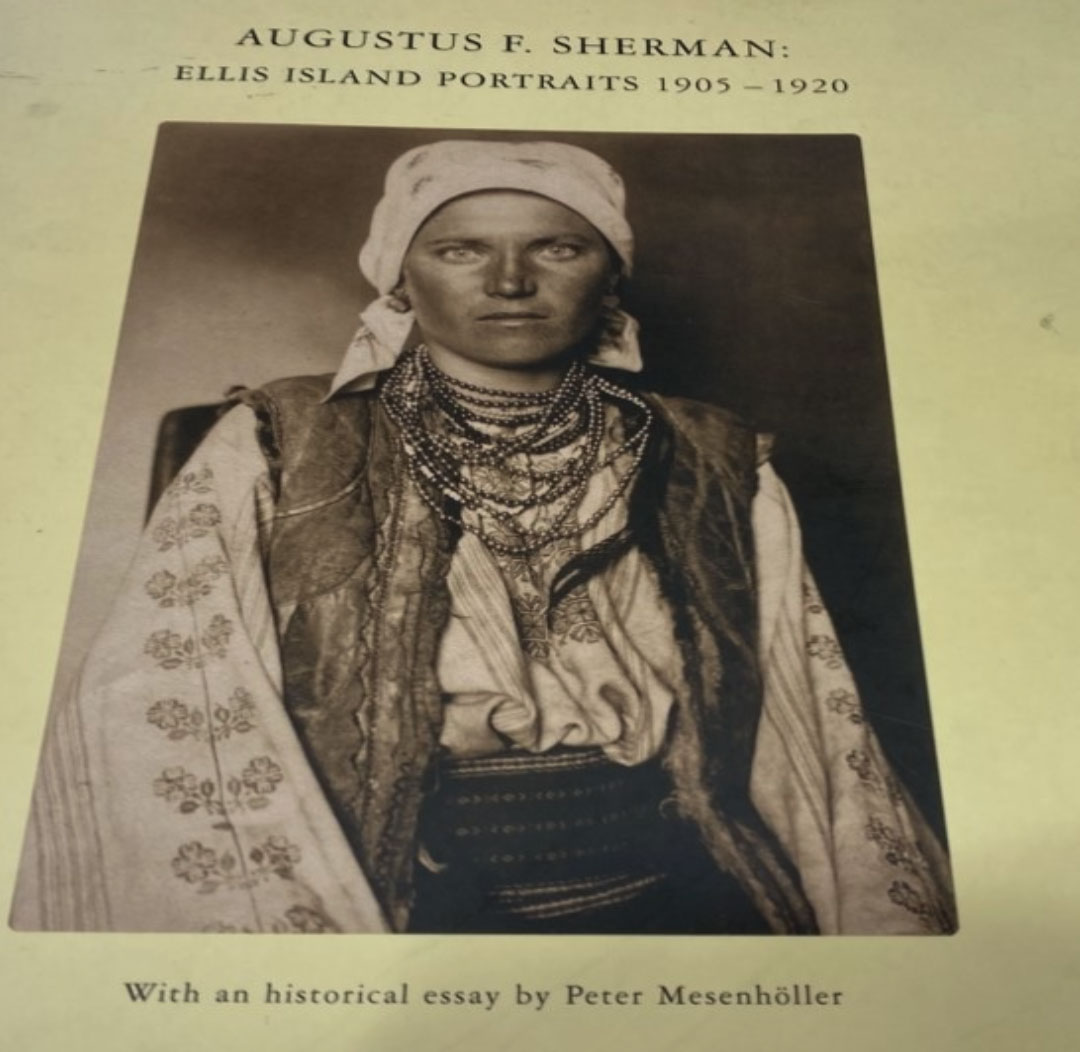
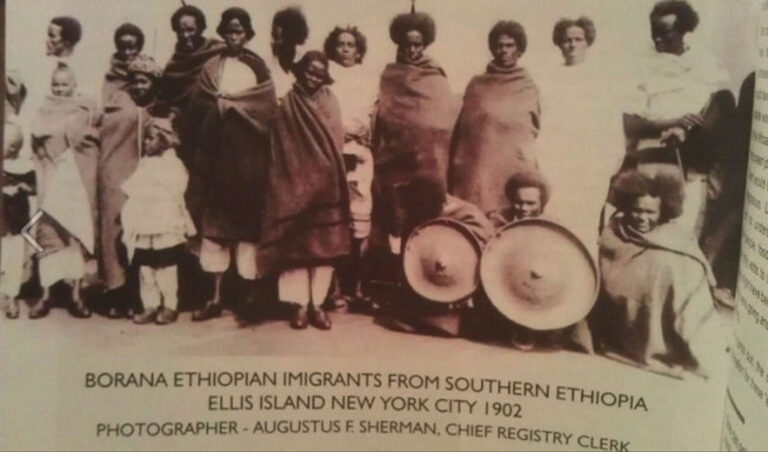
Between 1905 and 1920, Augustus F. Sherman photographed approximately 250 immigrants at Ellis Island, creating one of the most significant visual records of immigrant communities during this period. During his tenure at Ellis Island, Sherman photographed immigrants from across the world, including European and African communities, documenting the remarkable diversity of people who passed through the station.1Augustus F. Sherman, Borana Immigrants from Southern Ethiopia, ca. 1905–1920, photograph, in Ellis Island 2005 Exhibition (New York: U.S. National Archives, 2005). Among these photographs is the Borana Immigrants from Southern Ethiopia, Ellis Island, New York City, an image that was republished decades after its original publication.2Nina Bernstein, “From Ellis Island, Portraits of a New America,” New York Times, August 10, 2005, accessed May 17, 2026, https://www.nytimes.com/2005/08/10/travel/from-ellis-island-portraits-of-a-new-america.html As shown in the century-old portrait reproduced in Figure 1, the subjects are members of the Borana, an Oromo subgroup with historical roots in southern Ethiopia and northern Kenya. Their presence in the Ellis Island archive points to an African migration history that has received comparatively little attention in scholarship and public interpretations of the site.3Nina Bernstein, “From Ellis Island, Portraits of a New America,” New York Times, August 10, 2005, accessed May 17, 2026
The image itself is arresting: a solemn group of Borana Ethiopian immigrants stands in line, wrapped in traditional cloaks and blankets; their presence quietly commands attention. Men and women, young and old, pose with composure. Some hold circular shields that reflect their cultural heritage. Their expressions capture resilience, uncertainty, and hope, offering an intimate glimpse into a journey far from home.
The photograph therefore raises questions that extend beyond the image itself: Who were these immigrants? What brought them to Ellis Island, and how did they understand and represent their cultural identities in an unfamiliar setting? Read alongside the broader Ellis Island archive, Sherman’s portrait offers an opportunity to recover an overlooked chapter of Borana history and to broaden our understanding of who participated in the global movements that shaped the early twentieth century. It challenges Ellis Island narratives that have tended to foreground European migration, reminding us that the immigration station was part of a much wider and more complex history of global movement.
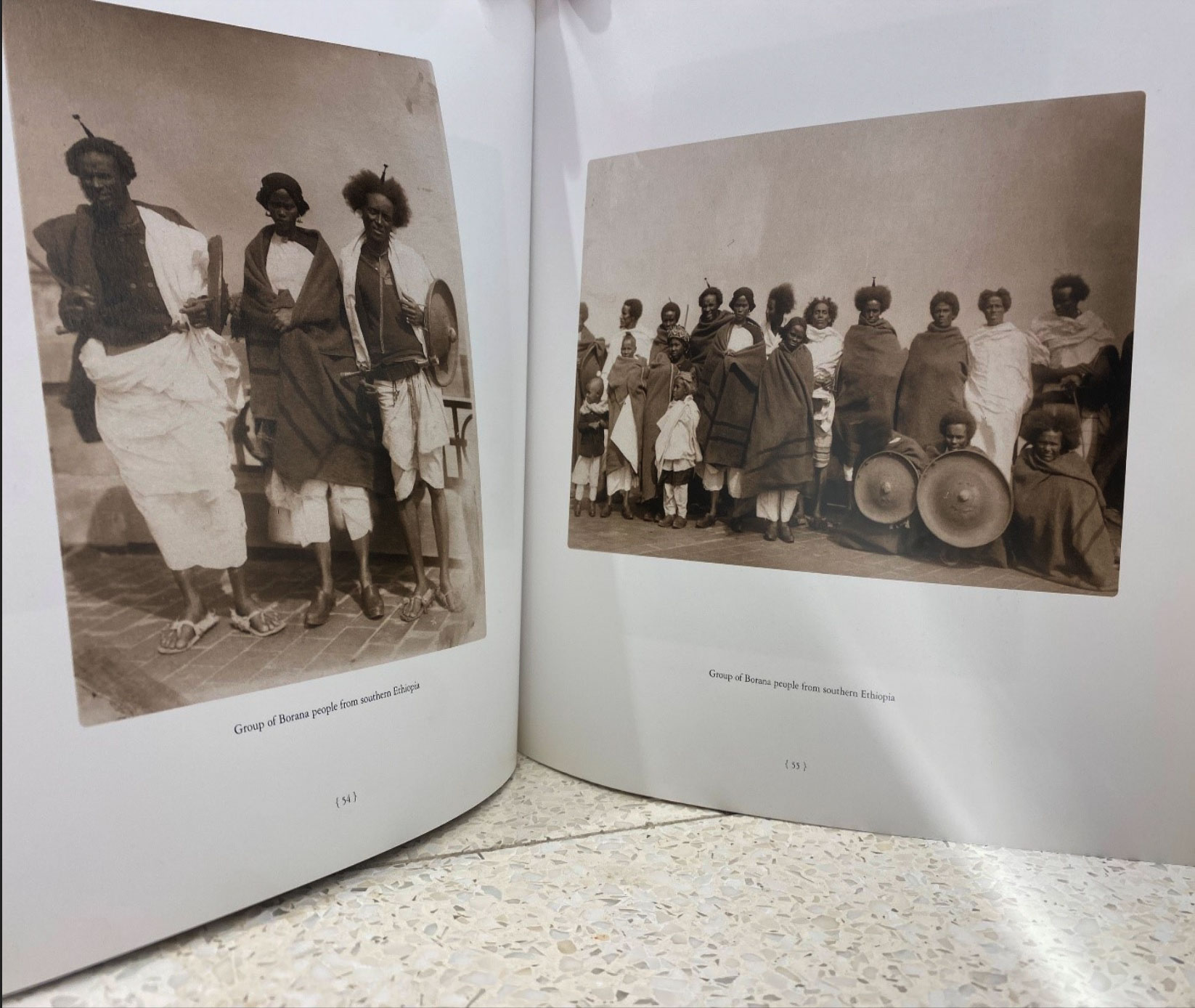
For example, Nina Bernstein’s 2005 article in The New York Times, “From Ellis Island, Portraits of a New America,” discusses Sherman’s photographs and highlights how they reveal the diversity of immigrant experiences through clothing, appearance, and personal expression.4Nina Bernstein, “From Ellis Island, Portraits of a New America,” New York Times, August 10, 2005, accessed May 17, 2026 Bernstein emphasizes the historical significance of Sherman’s work in documenting immigrant identities and showing the human experiences behind immigration statistics. The institutional setting of Ellis Island influenced how immigrants were photographed, reflecting both personal expression and the administrative practices used to document arriving populations.5National Park Service, “Statue of Liberty National Monument,” U.S. Department of the Interior, accessed March 12, 2026, https://www.nps.gov/stli/index.htm. Thus, we must gather materials that supplement these photographs to construct a fuller narrative.
Ellis Island is widely remembered as a gateway for millions of immigrants, a history often told through the experiences of European migrants. Yet reconstructing the histories of those who fall outside this familiar narrative requires piecing together evidence that is often fragmented across visual archives, immigration records, and later historical interpretations. Examining such an archival collection requires not only attention to what has been preserved, but also attention to how such records were created, categorized, interpreted, and subsequently incorporated into historical narratives. In this sense, looking beyond Ellis Island’s most familiar stories does more than add overlooked experiences to an established narrative; it offers a way to reconsider how that narrative was constructed in the first place.
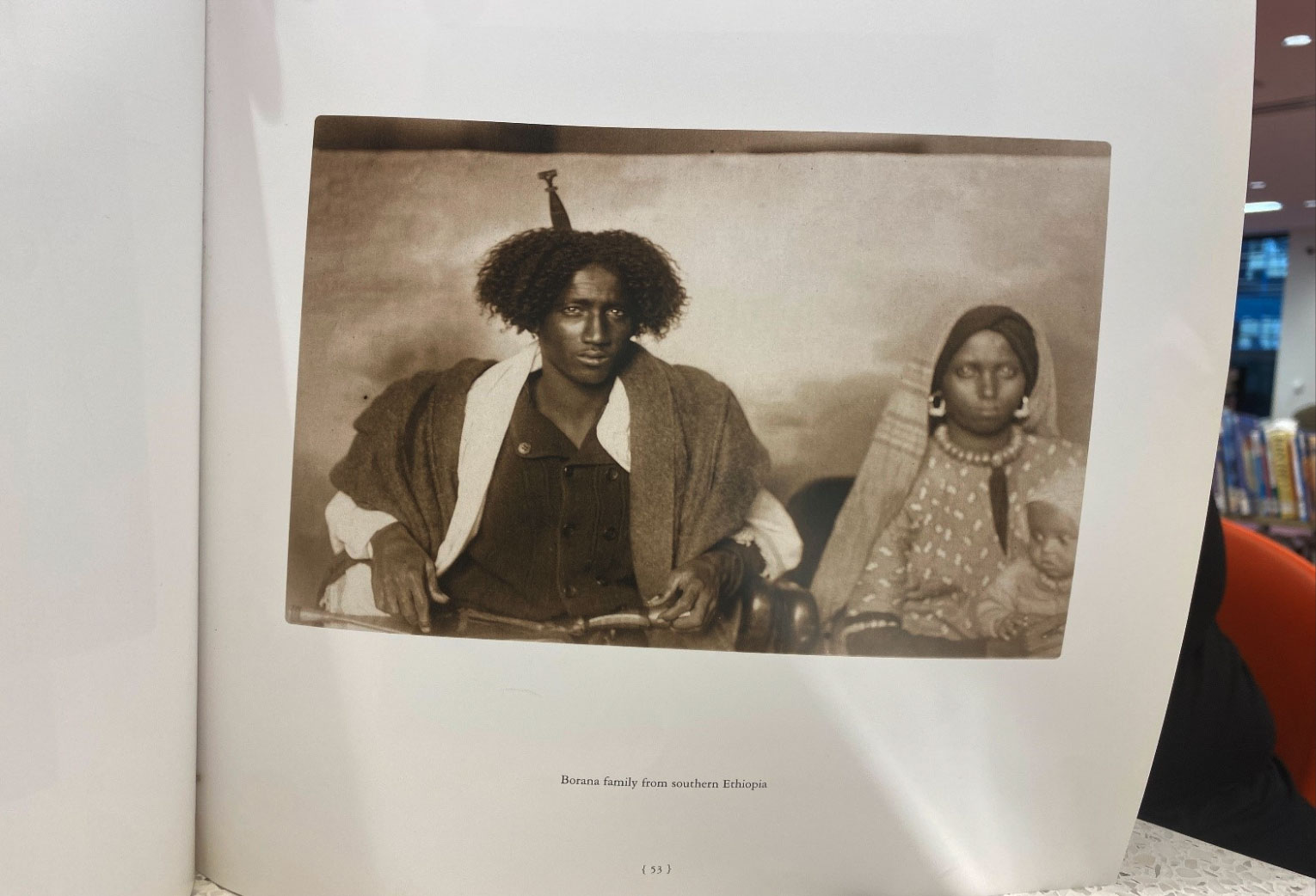
Members of the Borana community and researchers, including oral historian Borbor Bule and Professor Gufu Oba, continue to investigate the possible histories and identities of the individuals represented in Sherman’s photographs.6Borbor Bule, oral historian and honorary doctor, interviewed by Sora Halake, October 2022. According to Professor Gufu Oba, European explorers and colonial actors were active in the Horn of Africa during the late nineteenth and early twentieth centuries, engaging with local communities through exploration, commercial trade, missionary activities, scientific study, and the removal of cultural artifacts.7Gufu Oba, emeritus professor, Norwegian University of Life Sciences, interview by Sora Halake, January 2026.
According to oral histories preserved within the Borana, cultural exhibitions and performances were likely among the reasons Borana individuals were taken from their communities. Borbor Bule, a Borana oral historian, recounts that European travelers took individuals from the Borana community to Europe, along with cultural objects associated with Borana leaders. Among these objects, he identifies the ceremonial whip carried by traditional authorities as a marker of leadership and social standing within Borana society.8Borbor Bule, oral historian and honorary doctor, interviewed by Sora Halake, October 2022. Bule recalled that Borana individuals were taken from Ana Eka, a settlement located approximately 600 kilometers from Addis Ababa, Ethiopia’s capital. He further stated that an unknown number of villagers were taken from the same area and were never seen again.9Borbor Bule, oral historian and honorary doctor, interviewed by Sora Halake, October 2022.
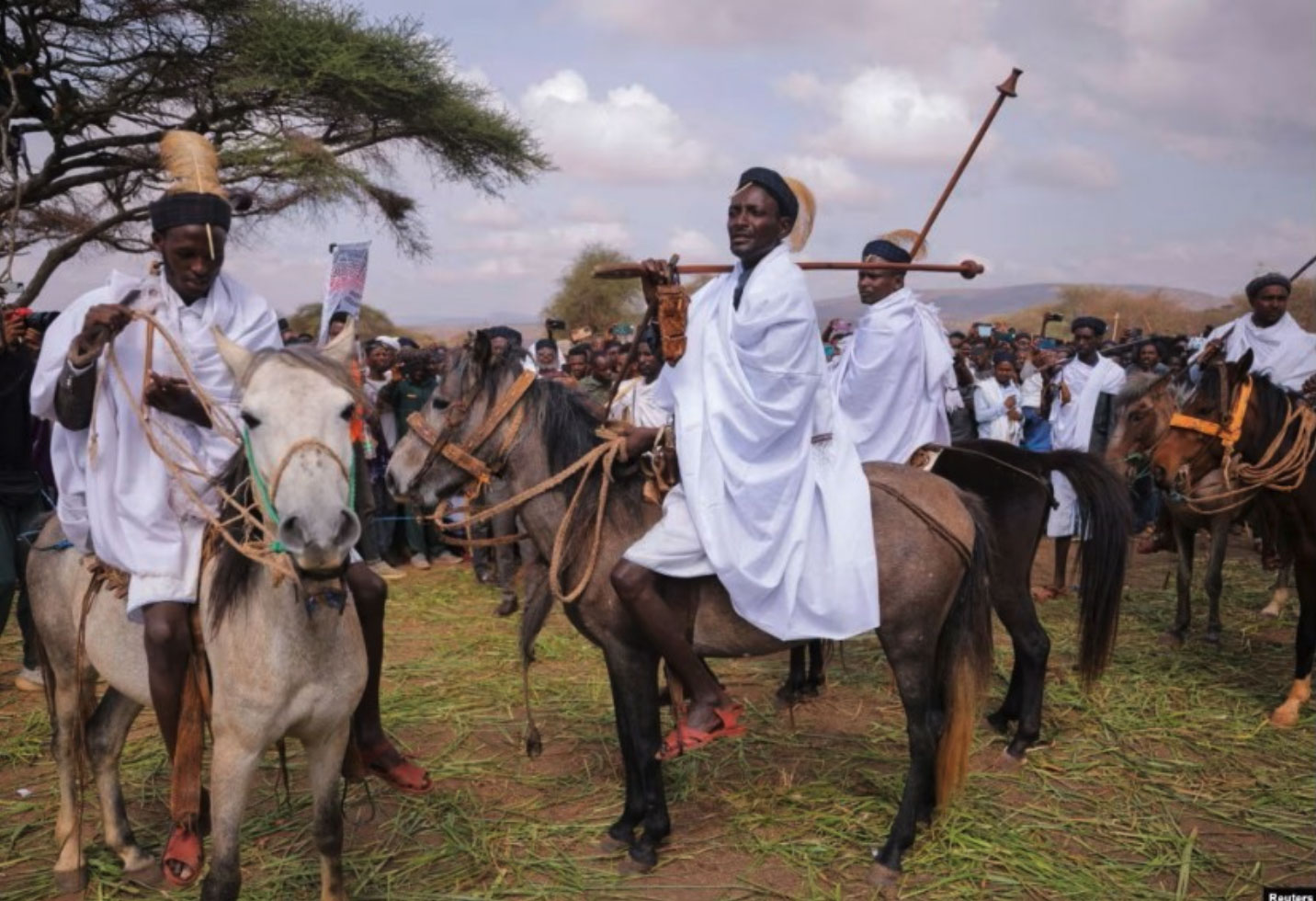
The ceremonial practices of Borana Gadaa leaders provide an essential context for sustaining cultural continuity across generations and communities. These practices are not simply ceremonial; they are embedded in a broader system of social organization that has helped communities respond to changing environmental and political challenges. As Professor Gufu Oba has documented, Borana pastoral communities have demonstrated considerable resilience and adaptability in navigating these challenges through social institutions and community-based practices developed over generations.10Gufu Oba, emeritus professor, Norwegian University of Life Sciences, interview by Sora Halake, January 2026.
At the same time, the connection between these broader historical patterns and the individuals depicted in Augustus F. Sherman’s Ellis Island photographs cannot yet be established with certainty. Further archival and oral-history research is therefore needed to determine who these individuals were, why they traveled, and how, or whether, their experiences connect to the Borana communities and traditions described here.
In 1900, immigrants from Ethiopia and East Africa rarely arrived in the United States through direct transatlantic routes. Many migration journeys involve multiple stages, and limited historical documentation makes it difficult to reconstruct.11Smithsonian Institution, National Museum of American History, “A Nation of Nations: Immigration in America,” accessed April 20, 2026, https://www.si.edu/exhibitions/nation-nations:event-exhib-4239. The specific transportation routes used by the Borana individuals photographed at Ellis Island have not yet been established.
Between 1892 and 1954, Ellis Island served as one of the United States’ principal immigration gateways, processing more than 12 million arrivals. The voyage to Ellis Island could be physically and emotionally demanding for arriving passengers.12Maya Tirone-Goehring, Ellis Island and American Immigration History: A Closer Look at History on Ellis Island and American Immigration Waves During the Nineteenth and Early Twentieth Centuries (Bard College, 2024), The Smithsonian Institution’s National Museum of American History notes that many immigrants described ocean voyages as crowded, dark, unsanitary, and uncomfortable, with many passengers traveling in steerage, a section of ships with limited facilities and little privacy.13Smithsonian Institution, National Museum of American History, “A Nation of Nations: Immigration in America,” accessed April 20, 2026
These migration experiences unfolded amid significant political and social transformations on both sides of the Atlantic. As migration historian Benedetta Rossi observes, African migration has long been shaped by complex patterns of mobility, displacement, and encounters with changing political, economic, and imperial systems.14Benedetta Rossi, “Migration History and Historiography,” in Oxford Research Encyclopedia of African History, ed. Thomas Spear (New York: Oxford University Press, September 2018), https://doi.org/10.1093/acrefore/9780190277734.013.191. Although Ethiopian immigration to the United States is predominantly associated with the larger refugee movements that followed the 1974 Ethiopian Revolution, historian Solomon Addis Getahun records that Ethiopian migration began much earlier, with small numbers of Ethiopians arriving in the United States during the early twentieth century.15Solomon Addis Getahun, The History of Ethiopian Immigrants and Refugees in America, 1900–2000: Patterns of Migration, Survival, and Adjustment (New York: LFB Scholarly Publishing LLC, 2007), 11–46. The Borana individuals photographed at Ellis Island represent a rare visual record of an early documented Ethiopian presence in the United States.16Solomon Addis Getahun, The History of Ethiopian Immigrants and Refugees in America, 1900–2000: Patterns of Migration, Survival, and Adjustment (New York: LFB Scholarly Publishing LLC, 2007), 11–46. At the same time, Ethiopia was undergoing its own profound political transformation. During the reign of Emperor Menelik II (1889–1913), the Ethiopian state expanded and consolidated its authority, including in southern territories inhabited by Oromo communities such as the Borana.17Getachew Kassa, “An Overview of Root Causes of Problems That Currently Affect Borana Pastoralists of Southern Ethiopia,” in Resource Alienation, Militarization and Development: Case Studies from East African Drylands, ed. Mustafa Babiker (Addis Ababa: Organization for Social Science Research in Eastern and Southern Africa [OSSREA], 2002), 67–76.
For African migrants, reconstructing their arrival in the United States is complicated by the ways in which people were documented and classified. Differences in legal status, incomplete records, shifting geographic designations, and variations in how officials recorded migrants’ origins could leave gaps between a person’s lived identity and the identity preserved in the archive.18National Archives Foundation, “Information Shared with ACSTRAP,” unpublished research material transmitted by email to Sora Halake, 2026. At Ellis Island, arrivals underwent medical and legal inspections as part of the admission process. For passengers who did not speak English, these procedures could introduce additional challenges as they navigated an unfamiliar institutional environment. The resulting records, including inspection documents, passenger manifests, and photographs, now provide an invaluable window into migration at the turn of the twentieth century. However, such records capture migrants through the categories and practices of the institutions that recorded them, rather than necessarily preserving how migrants understood themselves. Thus, despite ongoing digitization efforts, important research questions remain about the lives of early Ethiopian arrivals.19National Park Service, “Statue of Liberty National Monument,” U.S. Department of the Interior, accessed March 12, 2026, https://www.nps.gov/stli/index.htm.
The culture of their originating geography may provide direction. The Borana have a long history of practicing the Gadaa system, an indigenous system of democratic governance that organizes leadership, social responsibilities, and community decision-making, according to Borbor Bule.20Borbor Bule, oral historian and honorary doctor, interviewed by Sora Halake, October 2022. The system operates through an age-grade structure and has historically guided political, social, religious, and cultural life among Oromo communities in Ethiopia and northern Kenya.21Asmarom Legesse, Gada: Three Approaches to the Study of African Society (New York: Free Press, 1973).
Anthropologist Asmarom Legesse, who devoted decades to studying Oromo society and the Gadaa system, described the Gadaa system as a highly developed form of indigenous governance characterized by leadership rotation, collective decision-making, and social responsibility.22Asmarom Legesse, Gada: Three Approaches to the Study of African Society (New York: Free Press, 1973). Furthermore, scholars such as Dr. Wogari Negari argue that the Gadaa system is among the Oromo people’s most significant contributions to Ethiopia and humanity, offering a model of democratic governance, community participation, and sustainable development.23Wogari Negari, “Indigenous Knowledge for Good Governance and Development: Unleashing the Wisdom of the Gada System,” Amity Journal of Management 6, no. 2 (2018): 13–25.Through the Gadaa system, Borana Gadaa leaders are prepared for leadership responsibilities through generations of customary education, during which they learn principles of governance, conflict resolution, and community responsibility.24Asmarom Legesse, Gada: Three Approaches to the Study of African Society (New York: Free Press, 1973).
The Gadaa system continues to hold cultural and social significance among Oromo communities.25UNESCO, “Gada System,” Intangible Cultural Heritage of Humanity, accessed May 17, 2026, https://ich.unesco.org/en/RL/gada-system-01079. In 2016, UNESCO inscribed the Gadaa system on the Representative List of the Intangible Cultural Heritage of Humanity, recognizing its importance as a traditional system of governance and knowledge transmission. 26UNESCO, “Gada System,” Intangible Cultural Heritage of Humanity, accessed May 17, 2026, https://ich.unesco.org/en/RL/gada-system-01079.
The Borana Gadaa system offers one important framework for understanding the cultural traditions of Borana individuals who traveled beyond their communities. Such traditions provide a starting point for asking more precise questions about the people behind Sherman’s photographs and the historical circumstances that brought them to Ellis Island.
Ultimately, Sherman’s portraits preserve more than images of immigrants; they preserve an opening into histories that remain incomplete. Their significance lies not only in documenting an African presence within the Ellis Island archive, but also in challenging researchers to look beyond the photograph itself–to passenger records, oral histories, community knowledge, and other archival sources–to reconstruct the lives and identities of the people pictured. More than a century later, these images continue to remind us that historical memory is not simply about what an archive preserves, but also about what remains to be discovered.
Endnotes
- Augustus F. Sherman, Borana Immigrants from Southern Ethiopia, ca. 1905–1920, photograph, in Ellis Island 2005 Exhibition (New York: U.S. National Archives, 2005).
- Nina Bernstein, “From Ellis Island, Portraits of a New America,” New York Times, August 10, 2005, accessed May 17, 2026, https://www.nytimes.com/2005/08/10/travel/from-ellis-island-portraits-of-a-new-america.html
- National Park Service, “Statue of Liberty National Monument,” U.S. Department of the Interior, accessed March 12, 2026, https://www.nps.gov/stli/index.htm.
- Borbor Bule, oral historian and honorary doctor, interviewed by Sora Halake, October 2022.
- Borbor Bule, oral historian and honorary doctor, interviewed by Sora Halake, February 2026.
- Gufu Oba, emeritus professor, Norwegian University of Life Sciences, interview by Sora Halake, January 2026.
- Statue of Liberty–Ellis Island Foundation, “Passenger Search Database,” accessed April 16, 2026, https://www.statueofliberty.org/ellis-island/passenger-search/
- Maya Tirone-Goehring, Ellis Island and American Immigration History: A Closer Look at History on Ellis Island and American Immigration Waves During the Nineteenth and Early Twentieth Centuries (Bard College, 2024), https://digitalcommons.bard.edu/history_mat/40/.
- Smithsonian Institution, National Museum of American History, “A Nation of Nations: Immigration in America,” accessed April 20, 2026, https://www.si.edu/exhibitions/nation-nations:event-exhib-4239.
- Solomon Addis Getahun, The History of Ethiopian Immigrants and Refugees in America, 1900–2000: Patterns of Migration, Survival, and Adjustment (New York: LFB Scholarly Publishing LLC, 2007), 11–46.
- Benedetta Rossi, “Migration History and Historiography,” in Oxford Research Encyclopedia of African History, ed. Thomas Spear (New York: Oxford University Press, September 2018), https://doi.org/10.1093/acrefore/9780190277734.013.191.
- Getachew Kassa, “An Overview of Root Causes of Problems That Currently Affect Borana Pastoralists of Southern Ethiopia,” in Resource Alienation, Militarization and Development: Case Studies from East African Drylands, ed. Mustafa Babiker (Addis Ababa: Organization for Social Science Research in Eastern and Southern Africa [OSSREA], 2002), 67–76.
- National Park Service, “Ellis Island,” Statue of Liberty National Monument, U.S. Department of the Interior, accessed March 12, 2026, https://www.nps.gov/elis/index.htm.
- National Archives Foundation, “Information Shared with ACSTRAP,” unpublished research material transmitted by email to Sora Halake, 2026.
- Asmarom Legesse, Gada: Three Approaches to the Study of African Society (New York: Free Press, 1973).
- UNESCO, “Gada System,” Intangible Cultural Heritage of Humanity, accessed May 17, 2026, https://ich.unesco.org/en/RL/gada-system-01079.
- Wogari Negari, “Indigenous Knowledge for Good Governance and Development: Unleashing the Wisdom of the Gada System,” Amity Journal of Management 6, no. 2 (2018): 13–25.
About the Author
Sora Halake is a veteran multimedia journalist based in Washington, D.C. His reporting has appeared in outlets including Voice of America and Forbes. He has covered stories across the African continent, as well as major global events such as U.S. presidential elections, presidential inaugurations, and other international political developments.
Sora has interviewed a wide range of high-profile figures, including U.S. senators, European Union election observers, officials from the United States Agency for International Development, the United Nations, the National Oceanic and Atmospheric Administration, and representatives associated with the Olympic Games. His work has appeared across multiple print, broadcast, and digital platforms.
About the Africa Center for Strategy & Policy
The Africa Center for Strategy & Policy (ACSTRAP) publishes policy and strategy reports focused on African governance, development, and institutional analysis. ACSTRAP is a nonpartisan think tank committed to African-centered and data-driven approaches to policy evaluation, strategic development, and research concerning African governments, societies, and stakeholders.
The Africa Center for Strategy & Policy does not take institutional positions on policy or strategic issues and is not affiliated with any government. All opinions, conclusions, and recommendations expressed in its publications are solely those of the author(s).
Copyright © The Africa Center for Strategy & Policy. All rights reserved. No part of this publication may be reproduced or transmitted in any form, electronic or mechanical, including photocopying, recording, or information storage and retrieval systems, without prior written permission from the publisher, except for brief quotations used in reviews or scholarly citation.
United States Headquarters
Africa Center for Strategy & Policy
1300 I Street NW, Suite 400 E
Washington, DC 20005
info@africacfsp.org
https://www.acstrap.org
Africa Headquarters
Africa Center for Strategy & Policy
Britam Towers, 24th Floor
Hospital Road, Upper Hill
Nairobi 12295, Kenya
info@africacfsp.org
https://www.acstrap.org

Based on your interests, you may also wish to read:
- The Socio-economic Impact of COVID-19 on the African Economy
- Protection of Civilians After UNAMID? Rising Violence Amid the Mission’s Looming Exit
- Confronting the Overlap of Sextortion and Natural Resources in Kenya
- A Crucial Barrier to Covid-19 Response in Africa: Public Trust in Government Institutions