
The Twin Instruments of Power Consolidation in Ethiopia: National Dialogue and War Narratives
Milkessa Gemechu, Assistant Professor of Political Science, Albion College
milkessam@gmail.com
This article argues that Ethiopia’s Prime Minister Abiy Ahmed has employed the concept of “national dialogue” not to end civil wars and build lasting peace, but as an instrument of power consolidation aimed at advancing his vision of reshaping the Ethiopian state and society in his own image, even as the country remains embroiled in civil wars across several regions.
Over the past several years, anyone closely following Ethiopia’s state-controlled mainstream media would observe two deeply intertwined themes dominating public discourse: the national dialogue process and the narratives surrounding ongoing conflicts. These two agendas represent two sides of the same coin in contemporary Ethiopia’s political landscape. This paper argues that Prime Minister Abiy Ahmed has employed the concept of “national dialogue” not to end civil wars and build lasting peace, but as an instrument of power consolidation aimed at advancing his vision of reshaping the Ethiopian state and society in his own image, even as the country remains embroiled in civil wars across several regions.
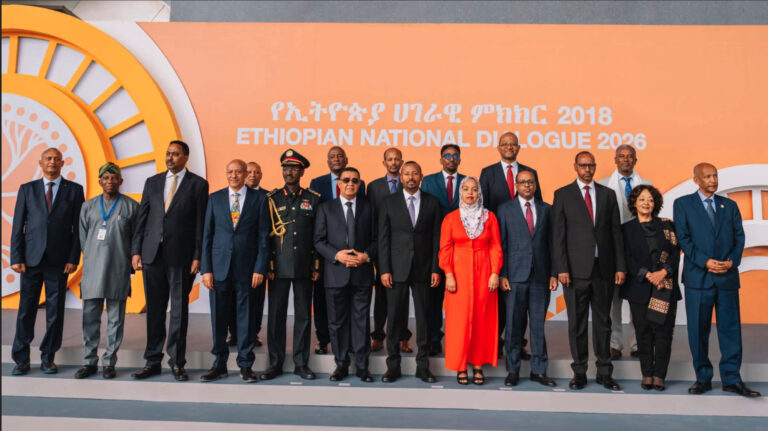
Amidst the ongoing civil wars in the Amhara and Oromia regions—the two largest regional states in Ethiopia—the government launched a widely criticized1Addis Standard. “TPLF-Reinstated Tigray Regional State Rejects National Dialogue Forum, Says Region Will Not Participate.” Addis Standard, July 2026.National Dialogue Conference on July 15, 20262Addis Standard. “Ethiopia’s Month-Long National Dialogue Forum Opens Amid Criticism from Opposition Parties.” Addis Standard, July 15, 2026., bringing together 4,000 participants selected through the ruling Prosperity Party’s structures. The conference is expected to conclude its “deliberations” within a month and forward its decisions to the relevant authorities for implementation. These decisions are expected to result in major constitutional changes in the country. From the outset—from the establishment of the Ethiopian National Dialogue Commission to the agenda-setting process and now the deliberation stage—the country’s major political elites and opposition forces, both armed and unarmed, have been neglected or excluded3Wazema Radio. “Ethiopia’s National Dialogue: Can It Shape Abiy Ahmed’s Political Project?” Wazema Briefings, July 27, 2026. from the process. Key political and armed actors, including the Tigray People’s Liberation Front (TPLF), Oromo Liberation Army (OLA), Amhara Fano, Oromo Federalist Congress, Ogaden National Liberation Front (ONLF), and many others, have been excluded from the dialogue and have all rejected it.4Wazema Radio. “Ethiopia’s National Dialogue: Can It Shape Abiy Ahmed’s Political Project?” Wazema Briefings, July 27, 2026. The conference aimed at reshaping the constitution is taking place while civil war continues to rage in the Oromia and Amhara regions, with another potential conflict looming over the Tigray region. As a result, one could argue that the ruling party and its affiliates exercise near-total control over the ongoing “dialogue” and its eventual outcomes.
In both theory and practice, national dialogues are inclusive, broad-based, and participatory negotiation processes designed to resolve deep-rooted political crises and violent conflicts. They typically bring together the country’s principal political elites and stakeholders—both armed and unarmed—with the aim of ending civil wars and facilitating political transitions toward peace and democracy.
So, what is the objective of Ethiopia’s national dialogue? Does it seek to end the ongoing civil wars, prevent future conflicts, and build a lasting peace? I would argue that it does not. In articles I wrote for Al Jazeera5Milkessa Gemechu, “Ethiopia’s New ‘National Dialogue’ Cannot Deliver Inclusive Peace,” Al Jazeera, January 27, 2022. in January 2022 and Addis Standard6Milkessa Gemechu, “What to Expect from the Ethiopian ‘National Dialogue’?” Addis Standard, June 8, 2024. in 2024, I argued that Prime Minister Abiy Ahmed initiated this “national dialogue” primarily to consolidate his political power. I not only maintain that position but further argue that the dialogue has become an extension of his instruments of war. Rather than serving as a genuine mechanism for conflict resolution, it functions as a tool of political deception and propaganda, diverting public attention from the country’s most pressing challenges: the civil wars in major regions, the resulting governance crisis, authoritarian rule, worsening socioeconomic conditions, and other indicators of state failure.7The Fund for Peace, “Fragile States Index: Country Data,” Fragile States Index, accessed July 27, 2026.
The Ethiopian National Dialogue Commission was established in December 2021 through Proclamation No. 1265/2021 by merging two predecessor bodies: the Reconciliation Commission, formed in 2018, and the Administrative Boundary and Identity Issues Commission, established in 2019. The Commission was therefore created amidst the Tigray war, and its commissioners were appointed without the participation of the country’s major opposition forces. According to the Commission, it spent four years (2022–2026) collecting public agendas, gathering more than 2,000 proposals before narrowing them down to just eight for deliberation at the conference.88 Ethiopian National Dialogue Commission, “National Dialogue Forum Preparations Enter Final Stage as Commission Confirms Readiness,” Ethiopian National Dialogue Commission, July 6, 2026. See also EBC. “የኢትዮጵያ ሀገራዊ ምክክር ኮሚሽን መግለጫ,”Jul 25, 2026
These eight agendas include9Ethiopian News Agency, “National Dialogue Commission Unveils Eight Major Agenda Pillars to Shape Ethiopia’s Future,” Ethiopian News Agency, June 24, 2026: (1) state-building, which aims to “settle” issues related to national identity, historical narratives, social cohesion, and the future direction of the Ethiopian state; (2) the structure and form of government, including possible revisions to the federal and parliamentary systems; (3) the status of the federal cities of Addis Ababa and Dire Dawa; (4) religious affairs, with the stated aim of “strengthening state-religion relations”; (5) judicial independence and the rule of law; (6) socioeconomic affairs; (7) anti-corruption and good governance; and (8) conflict resolution and peacebuilding. Many of these agenda items could result in constitutional amendments, while others may require only political commitments for implementation. The agendas that seek to alter the constitutional framework of ethno-national autonomy are likely to further inflame tensions with ethno-nationalist political and armed movements. Ethno-nationalist actors from Tigray, Oromia, Amhara, Somali, and other regions have accused the dialogue of being, in effect, Abiy Ahmed’s war by other means.10Addis Standard, “Opposition Coalition, OLF-OLA Dismiss National Dialogue as ‘Mock Process,’ Call for Unified Front Against Government,” Addis Standard, July 2026
In this way, the conference is expected to adopt its decisions at the level of the 500-member groups. Since the ruling Prosperity Party and its affiliated groups, including the Ethiopian Citizens for Social Change (EZEMA) and the Amhara National Movement (ANM), have dominated the dialogue, its decisions are likely to face significant opposition and backlash. As has happened in previous instances, Abiy Ahmed’s government may use state power to impose its political vision on the public. I argue that the decisions emerging from the national dialogue and any subsequent constitutional changes would not only intensify the ongoing conflicts in Amhara and Oromia but could also create new fronts of conflict, particularly among minority groups seeking greater political autonomy from the central government. Furthermore, even the apparent political disagreements11Wazemaradio, “ብልፅግና ፓርቲ በምክክር ጉባዔው ስለሚይዘው “አቋም” በዝግ ተወያየ፣ “ያፈነገጡ” አባላትን አስጠንቅቋል,” July 28, 2026. among Prosperity Party cadres participating in the conference could deepen internal divisions and create additional political challenges once the conference concludes.
The other major agenda dominating Ethiopia’s political landscape is the discourse of warfare—particularly diversionary and subversive propaganda. State-run Ethiopian mainstream media outlets, including the Ethiopian Broadcasting Corporation, Fana Broadcasting Corporation, and other stations, have been promoting a similar narrative targeting the emerging alliance among Amhara, Oromo, and Tigrayan forces. These state-affiliated media outlets accuse this armed alliance of serving as a foreign “Trojan horse” for what they describe as Ethiopia’s “historic enemies,” including Eritrea, Egypt, and Sudan. They have also particularly accused the Tigray People’s Liberation Front (TPLF) of aligning with Egypt against the Grand Ethiopian Renaissance Dam (GERD) on the Nile River, despite the lack of concrete evidence presented to support these claims. Through repeated “traitor” narratives, accusations, and documentaries programs, the Abiy administration appears to be attempting to externalize Ethiopia’s internal political crises by framing them as matters of national sovereignty. This strategy seeks to mobilize public support for the government’s continued military actions in Amhara, Oromia, and Tigray. It is important to recall, however, that the Abiy Ahmed government itself invited Eritrean forces into Ethiopia during the Tigray war (2020–2022), when those forces were accused by international organizations and human rights groups of committing war crimes and crimes against humanity.12Lauren Ploch Blanchard, Ethiopia: In Brief, Congressional Research Service Report R47898 (Washington, DC: Congressional Research Service, January 23, 2024).
Another significant development in the discourse of diversionary warfare propaganda has been Prime Minister Abiy Ahmed’s “From the River to the Sea” project. The project was first introduced in October 2023, when Abiy Ahmed presented the idea in Amharic to senior government officials.13Fana Television, “የታሪካዊው ጥያቄ ሕያው መሆን,” Jul 24, 2026 The concept holds that Ethiopia should regain sovereign control of the Nile River from the Red Sea to the Mediterranean, thereby securing direct access to the sea. Abiy announced this vision shortly after signing the Pretoria Cessation of Hostilities Agreement that ended the Tigray war—a conflict that devastated Ethiopia’s economy and contributed to the subsequent escalation of conflict in the Amhara region. To quote Prime Minister Abiy:
People may fear that this project (From the River to the Sea) could lead us to war with Eritrea and Djibouti. We were 50 million people; in 2030, we will be 150 million. One hundred and fifty million people cannot remain as geographic prisoners. This is the Red Sea. This is the Nile River. Ethiopia is located between these two. It does not work if you say this water is open for discussion and that water is not. Nature does not support that. Both the Red Sea and the Nile River are intertwined with Ethiopia; both are the foundation of Ethiopia’s development or destruction. We can draw on history, geography, economy, and ethnicity to advance our project. We lost the Red Sea during the last 30 years. To regain it, we do not need another 30 years. We will pay the ultimate sacrifice to achieve it. The reason Ethiopia lost its thousand-year jurisdiction over the Red Sea and became a geographic prisoner lies in domestic political problems caused by an unelected government.1414 Fana Television, “የታሪካዊው ጥያቄ ሕያው መሆን,” Jul 24, 2026 (Translation is mine.)
Because Prime Minister Abiy Ahmed launched his “From the River to the Sea” policy in 2023 shortly after his failure to eliminate the TPLF in Tigray and while announcing plans to disarm Amhara special forces and Fano, one could argue that he may have used this policy as diversionary warfare propaganda for domestic political purposes. Following the Tigray war, Ethiopia’s worsening economic crisis posed a serious challenge to his administration. Therefore, he needed a political strategy capable of diverting public attention from the country’s internal crises—a dynamic that has continued to the present. The announcement of the discourse surrounding access to the Red Sea also coincided with the outbreak of the civil war in Sudan in 2023. One could further speculate that such ambitious regional projects may have received support from the United Arab Emirates (UAE), which has had disagreements with Eritrea.15Afewerki Ghebremichael, “Why Is the United Arab Emirates (UAE) Accused of Destabilizing the Horn of Africa?” Setit, January 7, 2025
In Eritrea, Saudi Arabia has been a major investor and influential external actor.16Eritrea Focus, “Saudi Arabia’s Billion-Dollar Bid for Eritrea’s Assab Port,” Eritrea Focus, March 11, 2025 Reports have also alleged that Abiy Ahmed’s government offered military training facilities to Sudan’s Rapid Support Forces (RSF).17Giulia Paravicini and Reade Levinson, “Ethiopia Builds Secret Camp to Train Sudan RSF Fighters, Sources Say,” Reuters, February 10, 2026 Under Abiy Ahmed’s rule, Ethiopia maintains close ties with the UAE. Therefore, Abiy’s “From the River to the Sea” discourse should be understood within this broader geopolitical and subregional context.
In conclusion, Ethiopia’s ongoing wars and emerging conflict fronts are closely interconnected with the national dialogue process. Both, I argue, serve a common objective: the consolidation of political power. Abiy Ahmed is pursuing war and dialogue simultaneously as strategies to advance his political vision of reshaping the Ethiopian state and society in his own image. As Carl von Clausewitz famously stated, “War is a continuation of politics by other means.” Abiy ultimately seeks to become a powerful central leader by weakening regional forces and communities. In this pursuit, he may be willing to employ military instruments to impose the outcomes of the national dialogue. The national dialogue also serves purposes beyond domestic politics. It appears to be designed to influence the international community’s perception by creating the impression that the Abiy government has initiated an inclusive process to address Ethiopia’s deep-rooted political problems. Such an image carries significant implications for diplomacy and foreign assistance. Unfortunately, the national dialogue taking place under these conditions is unlikely to end the ongoing civil wars in Amhara and Oromia or prevent a potential renewed conflict in Tigray. If the constitutional autonomy rights of minority groups are undermined through the decisions of the national dialogue, new fronts of conflict could emerge. Thus, a process intended to end civil war and establish lasting peace may instead deepen political disagreements and serve as both an instrument and a cause of war and instability.
About the Author:
Milkessa Gemechu is an assistant professor of political science at Albion College, USA. He was a lecturer at colleges in Ethiopia and has brief experience serving in the Ethiopian government.
About the Africa Center for Strategy & Policy
The Africa Center for Strategy & Policy (ACSTRAP) publishes policy and strategy reports focused on African governance, development, and institutional analysis. ACSTRAP is a nonpartisan think tank committed to African-centered and data-driven approaches to policy evaluation, strategic development, and research concerning African governments, societies, and stakeholders.
The Africa Center for Strategy & Policy does not take institutional positions on policy or strategic issues and is not affiliated with any government. All opinions, conclusions, and recommendations expressed in its publications are solely those of the author(s).
Copyright © The Africa Center for Strategy & Policy. All rights reserved. No part of this publication may be reproduced or transmitted in any form, electronic or mechanical, including photocopying, recording, or information storage and retrieval systems, without prior written permission from the publisher, except for brief quotations used in reviews or scholarly citation.
United States Headquarters
Africa Center for Strategy & Policy
1300 I Street NW, Suite 400
E Washington, DC 20005
info@africacfsp.org
https://www.acstrap.org
Africa Headquarters
Africa Center for Strategy & Policy
Britam Towers,
24th Floor Hospital Road,
Upper Hill Nairobi 12295,
Kenya info@africacfsp.org
https://www.acstrap.org

Based on your interests, you may also wish to read:
- Imperial Reckoning: an exceptional investigation into the violence and brutality which characterized the end of empire in Kenya
- An Emerging Landscape of Terror in Mozambique: Implications for the Southern African Development Community
- ECOWAS’ Response to Coups in West Africa, 2020-2021
- Political Violence and Insecurity in Mali, Burkina Faso, and Niger: Understanding the Impact